Beauté Pacifique Gentle Facial Exfoliator for Sensitive Skin
Sponsored content
Beauté Pacifique is a skincare brand offering a full range of facial care, anti-age treatments, and prevention-focused products, including the Gentle Facial Exfoliator, a 100 ml physical exfoliator priced at $57 AUD. The product uses rounded pearl particles to remove dead skin cells without chemical irritation, making it a weekly exfoliation option suited to all skin types, including sensitive and reactive skin. This article breaks down how to decide whether a physical exfoliant like this one fits your skin routine, and what to look for when making that choice.
Why sensitive skin struggles with most exfoliants
Most exfoliants fall into two categories: chemical (acids like AHAs and BHAs) or physical (scrubs with abrasive particles). Both can cause problems for reactive skin, but for different reasons. Chemical exfoliants dissolve the bonds between skin cells. If your barrier is already compromised, that dissolution goes too deep too fast, triggering redness, stinging, or prolonged sensitivity.
Physical scrubs carry their own risk. Crushed walnut shells, apricot kernels, or sugar crystals have jagged, irregular edges that create micro-tears in the skin surface. You might not see them, but your barrier registers the damage — and responds with inflammation. That inflammation is what keeps sensitive skin locked in a cycle of peeling, tightness, and reactivity, which is why the method of exfoliation matters just as much as how often you do it.
What rounded pearls actually do differently
The Beauté Pacifique gentle facial exfoliator works on a simple mechanical principle. Its abrasive particles are perfectly rounded pearls rather than crushed minerals or plant matter. That shape distinction is not cosmetic marketing. It is the difference between rolling a smooth bead across skin and dragging a shard across it.
Rounded particles loosen dead skin cells by lifting them away from the surface. They do not catch, snag, or tear. Because the pearls are uniform in shape, pressure distributes evenly during application, meaning no single point of contact bears enough force to breach the barrier. This consistency of contact is particularly important for reactive skin types, where even minor localised pressure can trigger a disproportionate inflammatory response — something that irregular, crushed particles make almost impossible to avoid.
There is a secondary benefit worth noting. The formulation provides lubrication during use, which means the pearls glide rather than grind. Skin feels softened during the process itself, not just after rinsing. That combination of physical cell removal and simultaneous softening is what leaves skin silky smooth with an elevated moisture level, according to Beauté Pacifique's product description.
Four questions before choosing an exfoliant
If you have sensitive or reactive skin, run any exfoliant through these four checks before committing:
- Is the exfoliant chemical or physical? Chemical exfoliants (glycolic acid, salicylic acid, lactic acid) work by dissolving cellular bonds. If your skin stings or flares with acids, a physical option removes the variable of chemical sensitivity entirely. You control the pressure. You control the duration.
- Are the abrasive particles rounded or irregular? Look at the product description or ingredient list. Crushed shells, ground stones, or crystalline sugars all have sharp facets. Rounded synthetic pearls or jojoba beads are smoother alternatives. The shape determines whether exfoliation creates micro-abrasions or simply lifts surface cells.
- Does the product provide lubrication during use? A dry scrub dragged across damp skin generates more friction than necessary. Formulations that include emollients or lubricating agents reduce the mechanical stress on your barrier while the exfoliating particles do their work.
- Is the recommended frequency manageable? Daily exfoliation is too aggressive for most sensitive skin types. Once or twice a week gives cells time to recover and rebuild. Any product recommending daily physical exfoliation for sensitive skin is a red flag.
These four criteria narrow the field quickly. Most products fail on at least two.
How and when to use it in your routine
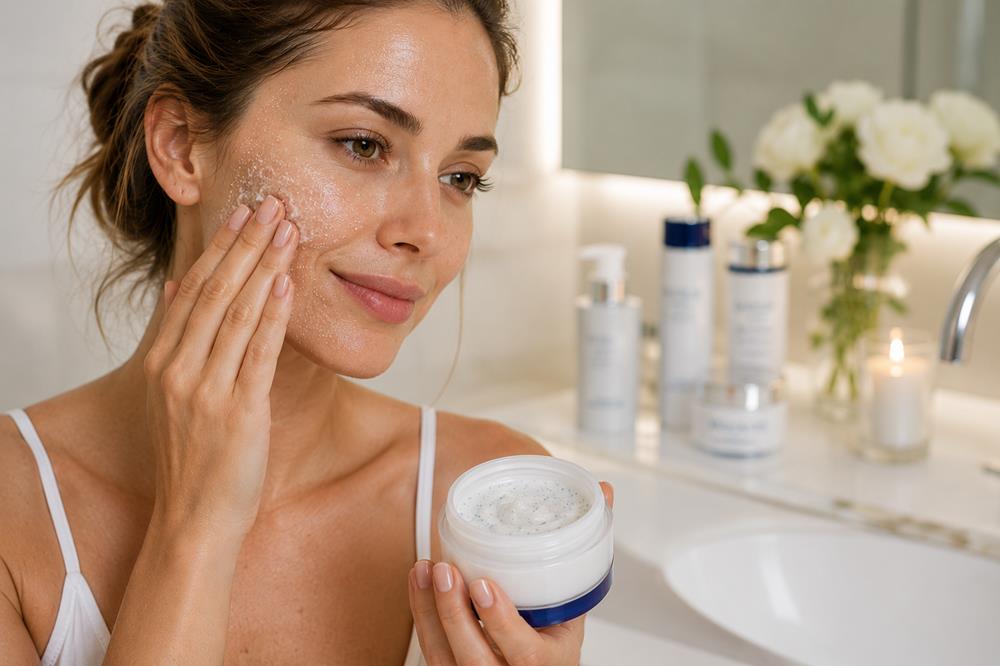
Application is straightforward. Cleanse first. Then apply the exfoliator to a moist face and neck, massaging gently in circular motions. Rinse thoroughly. Follow with your serum or moisturiser.
Once or twice a week is the recommended frequency. That spacing allows your skin's natural renewal cycle to work alongside the mechanical exfoliation rather than fighting against it. And because the product leaves skin with elevated moisture, your subsequent products absorb more efficiently on exfoliation days.
When a physical exfoliant is the right call
Not everyone needs to avoid chemical exfoliants. But certain skin profiles consistently respond better to a rounded-pearl physical approach.
- Skin that stings or reddens within minutes of AHA/BHA application
- Skin prone to contact dermatitis or eczema flares triggered by active ingredients
- People who want exfoliation without managing acid concentrations, pH levels, or wait times
- Those who prefer a tactile, once-a-week ritual they can feel working
- All skin types seeking gentle cell turnover without post-treatment downtime
Beauté Pacifique had three products recognised in the Prevention Beauty Awards 2025, tested by dermatologists, make-up experts, and beauty editors — reflecting a broader philosophy of effective results without aggressive delivery systems. The gentle facial exfoliator fits that pattern precisely.
Physical exfoliation is not inferior to chemicals. It is different. For reactive skin, that difference often means the gap between a product you can use consistently and one that sits unused because your skin cannot tolerate it. If your skin reacts to chemical exfoliants but still needs regular cell turnover, the mechanism matters more than the marketing.
A rounded-pearl physical exfoliant used once or twice a week is a practical middle ground — effective enough to make a visible difference, gentle enough not to set sensitive skin back.